Saturday, March 10, 2012

San Pedro de Atacama

After a 23 hour journey straight north we made it to the Atacama desert oasis of San Pedro de Atacama.  Unfortunately an Australian traveler had his bag stolen right from under his feet when he was sleeping - it had his passport in it.  Unlucky guy.

San Pedro is famous as the touristic center for the Atacama desert, as well as being the base for Chile´s largest archeaological sites.  Because it is so dry everything is very well preserved.  In the weeks prior to our arrival they had torrential rain, which occurs every 30 years or so, which meant that some of the roads had been flooded out and made some of the normal attractions either unavailable or hard (read expensive) to get to.  We settled into a hostel run by a some french people that catered to francophone tourists, recommended to us by Marc and Anja all the way back in Sucre.  While there I got some chess lessons from one of the owner´s boyfriend and played as much as I could - perhaps a new hobby in Inuvik.  The town is alright, with a chill vibe and lots of mud coloured/made buildings on streets meeting in a central square.  It has a great museum describing how Atacaman culture developed and was eventually influenced by the Tiwanakan culture out of Bolivia.  However, it was all a bit overun with tourists and gift shops and was also pretty expensive.

The view from the central square.  Typically there isn´t this much snow on the volcanoes surrounding the town, but because of the rains we were surrounded by about a dozen snow capped mountains like this.

The courtyard at our hostel, where we would read and I played some chess.

We spent two days exploring the surrounding area including visiting a pre-Incan fortress called Pukara de Quitor and then rented bikes to go into the Valle de la Luna (Valley of the Moon) - we had the whole place to ourselves for several hours as we got up early to make the 16km ride out of town.  We really enjoyed the scenery, perhaps not the sore butts.  It was all pretty breathtaking, and because of the recent rains there was a layer of salt on the hillsides that looked just like a powerdering of snow.  I didn´t really know what to expect from the Atacama desert but count it as one of the highlights of the trip so far.  It was pretty great scenery and a lot of fun getting out of town on our own. 

The Quitor fort, outside San Pedro de Atacama, is over 700 years old.  

To the east we saw snow capped volcanoes, one of which appeared to have smoke coming out (look at the right).

Welcome to San Pedro.

One of the bikes we rented.

Elise in the middle of some salt crusted hills.

From the top of a hill in the Valley of the Moon.
 
Probably the coolest thing we did while in San Pedro was visit a private observatory some 7km outside of town to star gaze.  Because of its high altitude and dry skies the region is perfect for excellent star watching.  Our explanations were all in spanish so we caught about half of what the guide told us.  She showed us constellations like Orion´s Belt and the Southern Cross,  two other galaxies called the Magallenic Clouds, Alpha Centauri (the closest star to the world), the bright stars Sirius and Canopus as well as Saturn and Mars.  It was amazing seeing Saturn through a super powerful telescope - you could see it´s rings!

Saturn´s rings through the telescope.

A cool time lapse photo with the milkyway in the background.

After San Pedro we were on our way back to Bolivia, traveling again through the Andes mountains.  We had to spend the night in Calama, Chile, where the dust from the world´s largest copper mine is visible high in the sky from town. Unfortunately tours were booked almost months in advance.  I got my haircut instead.

The third haircut of the trip.

While we enjoyed our time in both Argentina and Chile we were told the two countries are anomolies when compared to the rest of ´Latin America´.  They both have incredibly beautiful things to see and are fairly well organized, especially compared to Bolivia.  We were eager to get back to a little ´chaos´ in Uyuni once again and eventually to Peru and Ecuador.

Santiago, Chile

After traveling for 29 hours from Bariloche, through Mendoza, we arrived late in Santiago, Chile.  Again we were amazed at how fast the weather and vegetation changed on the west side of the Andes.  It is much more lush and humid on the Chilean side.  The country´s infrastructure is also very different from Argentina as Chile is sandwiched between the 20,000ft high Andes and the Pacific Ocean, sometimes just 70km seperating the two - Argentina has lots of wide open spaces between communities whereas in Chile we pretty much passed communities every ten minutes or so.  Santiago is home to 1/3 of Chile´s 18 million people, is enormous and is the country´s economic and government centre.  It is also considered the safest and most air polluted of South America´s big cities.

We had decided long ago that when we finally reached Santiago, the first big city since Buenos Aires in November (it was February 19th by this point), we would spend some airmiles and stay in a Best Western for a few nights.  It was great to stay in relative luxury for a while - guaranteed hot showers, king size bed, fresh linens, cable TV and room service!  We had pisco sours every night.  What a great drink.  After three nights at the Best Western we changed to a really great, chill, hostel that Mike and Kat had recommended.  What great meals!  While in Santiago we met up with Aussies Kat and Mike again for a delicious meal at the fish market (Mike and I agreed it was getting a bit weird bumping into eachother so much), took a city bus tour, I bought new shorts at an uber modern mall (with tears in my eyes - I loved those old shorts), dodged all sorts of young people making out, laid down in quiet municipal parks, ate at sidewalk restaurants, watched old fellows playing speed chess in the square, saw the fine art musem and generally enjoyed spending time in this fairly modern city in a comfy hotel and hostel.

We were struck with how efficient the city is (unlike Argentina all the bank machines gave you money and store owners didn´t hassle you for change) and how prosperous it all looked - there were building cranes all over the place.  It was much more American than any other place we´ve seen so far, with Starbucks and Burger Kings all over the place.  We also noticed lots of american music being played in people´s cars during rush hour.  At first we kind of fell in love with it however, during one conversation with a Guatemalan guy we found out that Chile might be a little too western for most South American tastes - ¨none of my friends from Latin America want to live here.  They come for school, then leave, it´s too boring¨.   Perhaps after chaotic Bolivia and ´slow´ Argentina Santiago felt a little like home to us?  We didn´t venture out of the center at all and perhaps we would have seen a different city altogether.  Chile is meant to be one of the continent´s most stratified in terms of income and has a lot of poor.

This will be Chile´s tallest buildling once built -  some 90 stories high.  Construction sites like this are all over the place in what they call ´Sanhatten´.

A little bit of home in Chile.

Tossing out my old shorts.  Look at how happy Elise is.  Look at how bemused the ladies in the back are.  

At the fish market.

At the main square

Same.
After five nights in Santiago we headed out on a night bus to the world´s driest place, the Atacama desert, which ironically enough had been suffering from floods in recent days.  Go figure.

Northern Argentinian patagonia

After saying goodbye to Kat and Mike, Elise and I said goodbye to eachother for a couple of nights.  As of that point we had been together 24 hours a day for five months and needed a bit of a break.  Quite normal we think. Elise went to Bariloche and me to El Bolsen before meeting again in Esquel, which are in Argentina´s northern patagonia region.  Elise will write about her time in Bariloche a bit later.

Entering Argentina the weather and vegetation immediately went drier than in Chile.  At points there were also lots of patches of ash on the ground from recent eruptions in Chile´s volcanoes.  As an Argentine told us months earlier ¨Chile has the volcanoes and we get the shit¨.  It looked like snow, complete with ashbanks on the sides of roads.  El Bolsen is described as the ´hippy capital´ of Argentina so I was expecting to see lots of dreadlocks, guitars, flutes and baggy cotton pants, and no surprises, I saw lots.  The town is in a mountain valley next to a fairly dirty river.  I spent two nights there camping, and one day hiked up the mountain to a refugio pretty high up.  It was a gorgeous hike, on a brilliantly sunny day.  I figure I walked over 30km that day so my legs were pretty hurtin´ a couple of hours after returning to my campsite.  After El Bolsen I happily rejoined Elise in a city called Esquel which was originally just supposed to be a one night stay to wait for Buenos Aires friends of ours to make it to their mountain home.  Well, apparently the day they were leaving, in fact the minute they were leaving, Guillermo broke his foot falling down their attic stairs, so they weren´t coming for at least another three weeks.  However, Guillermo got in touch with a friend of his who, with his wife, have a ranch in the mountains pretty near the town of Corcovado.  Raul and Ele were more than happy to not only host us but to come and get us.  So our one day stay turned into two in Esquel.  We hiked up to the local lake which is in a beautiful setting but wasn´t so enticing for swimming.  We stayed in a really nice hostel in Esquel and we were the only two guests there.  I think the owner, a 30-something guy from Buenos Aires, is feeling the pinch.

The view near El Bolsen, on the way up to the high refugio

At Laguna La Zeta, near Esquel.  It was nice to see Argentine families hanging out by the lake.

The day we got a ride from Esquel to Raul and Ele´s Ranch called ´Poncho Morro´ started with a surprise as a beat up Russian pick-up truck came to the hostel and a man with what appeared to be an eye patch got out to meet us.  Turns out the ´patch´ was one lense of sunglasses because he had just had some eye surgery, and the truck, well apparently they can´t be beat for cheap offroad vehicles.  We hopped in and some hours later we arrived at Poncho Morro, high up the mountainside near Corcovado.  The main house is under construction but one bedroom with ensuite bathroom was ready for us.  We were treated to incredible views from our room (especially the bathroom!), walks in the woods to a pond and waterfall and excellent homemade food.  We can´t wait to make empanadas when we head home.  The only bad part was when we walked over a bee´s nest and Elise got two stings and I one.  They itched like crazy after a couple of days!  The place has no electricity so nights were spent reading by candlight and getting astrology lessons from Ele, who is a passionate amateur physisist.  We spent three nights there before getting a ride back to Esquel and a bus to Bariloche.  We spent two days in Bariloche in the rain (saw Merryl Streep as ´The Iron Lady´ - great!) and then took a 29 hour journey to Santiago, Chile across the Andes mountains.  Along the way we passed the highest mountain in two hemispheres (south and west) and drove along one of the craziest switchback roads I have ever seen down into Chile from the border.

It´s hard to see, but one of Elise´s two stings.

A waterfall near the ranch.  We walked for about 2 hours with two local guides to get there.  The trail wasn´t clear so...

...the guides beat it out with machetes (they let us hold them but that was about it).

The candlelight dinner table at the ranch.

The incredible switchbacks down into Chile from the border near the top.  We left Argentina for good here.

Friday, February 17, 2012

Puerto Natales to Puerto Montt, Puerto Varas and Chiloe

We boarded the Navimag ferry on January 30 and shared a cabin with Mike and Kat for a 4 night day ferry ride from Puerto Natales to Puerto Montt.  The ferry goes through the Chilean fjords and islands, which are almost impossible to get to any other way.  It is a cargo ferry with room for 360 guests.  It was not anywhere near as nice as the MS Expedition but it was about a tenth the cost as well.  The food was fine and the views pretty nice.  We spent the time playing cards, having some beers, watching out the window and playing dancing bingo.  A pretty relaxing way to spend some time really.  Chilean Patagonia is much wetter than Argentina and is much greener as a result.  It reminded us a lot of coastal BC and the ferry from Port Hardy to Prince Rupert.  Pretty wild that we met someone who I had met in Tuktoyaktuk 7 years ago.  Her father used to work for the same company in Inuvik.  That was the second person from the north I´d bumped into in a week - on the trails in Torres del Paine we ran into a guy from Yellowknife I see at conferences and meetings from time to time.

Another glacier that produced some ice for our drinks at the bar...

...transported via this zodiac.

Elise and the Aussies on deck.

It is much greener in Chilean Patagonia than across the border.

Right away after getting to Puerto Montt the four of us took a bus to Puerto Varas.  It is a pretty, small city.  We toured the town a bit, took a bus into a nearby park where we saw some waterfalls and a lake surrounded by volcanoes, went whitewater rafting for a couple of hours (this time much better and warmer than near Mendoza, class III-IV - no pictures though) and caught the superbowl Chilean style.  In Chile it is still allowed to smoke in public places, includng all the bars, so we usually smelt like an ashtray when we came back to bed.  The aussies were not impressed with the game.

Falls on the Petrohue River near Puerto Varas.


The view of the Osorno volcanoe from Puerto Varas.

The four of us then rented a car in Puerto Varas and took off for a night to visit the island of Chiloe.  Chiloe is South America´s second biggest island (after Tierra del Fuego) with a different culture than Chile which is maintained.  We took a 30 minute ferry (saw lots of seals), had a traditional meal called ´Curanto´ (seafood, chicken, sausage and potatoes cooked under leaves in the ground), went to the coast to see Humboldt Penguins (not very close), stayed the night in a town called Castro (where we ate the biggest sandwhich I´ve ever seen) and spent the following day driving around to see various UN world heritage site churches.  All the while terrified because aussie Mike was driving on the wrong side of the road for the first time in his life.  The countryside again was really green with lots of fields of cows and nice farms.  It wasn´t the most exciting two days but was really pleasant.  After that Elise and I headed east back into Argentina to meet with a friend from Buenos Aires at his place in the mountains.  Mike and Kat headed north.  It was really great traveling with them, lots of fun.

That´s the biggest clam I´ve ever seen.

A UNESCO world heritage church, one of 16 on the island.
Traditional houses built to allow fishing boats to come right up at high tide.
 

Trekking in southern Patagonia

Shortly after returning to Ushuaia we headed on a bus with two Aussies (Mike and Kat) back to Rio Gallegos and then west to El Calafate.  We spent one quick night there - the hostel only had room in the storage room for us! - and next day went further north to the Parque Nacional de Los Glaciers and the town of El Chalten.  Mike and Kat stayed in El Calafate for a few days.  El Chalten is Argentina´s trekking capital and we were there during the high season.  It was the first time on our entire trip that we had to consider booking hostels and buses in advance, which we´ve had to do since.  The park was beautiful however.  We spent one night in an El Chalten hostel and next day started off on a 3 night trek through the park - just us and about 10,000 others.  The trails were like highways.  We spent one night in a tent city at a glacier lake at De Agostini.  We counted over 70 tents.  Despite all the people it was pretty quiet and clean and you can drink the water out of streams or rivers.  Next day we hiked over to another site called Poncenot where we stayed for two nights.  The weather had been typically gorgeous with no clouds and hot sun for weeks so we felt pretty confident of seeing the sunrise on Mount Fitzroy one morning.  We woke up at 4am and hiked up to a lookout with about 100 other people (the trail of headlamps on the mountainside was really cool) only to see the sunrise in total clouds.  Still beautiful, but we couldn´t see the big mountain.  The next day was clear skies, go figure.  I went on my own to a glacier lake early in the morning to have my breakfast.  I was there by myself for a while, until a young frenchman showed up and gave me sh*t for tossing rocks at a piece of ice - "you are destroying nature".  I called him ´papa´.  That day we hiked back to El Chalten, had beers and wine with two other aussies we met (Ben and Kerryn) and next day on down to El Calafate.

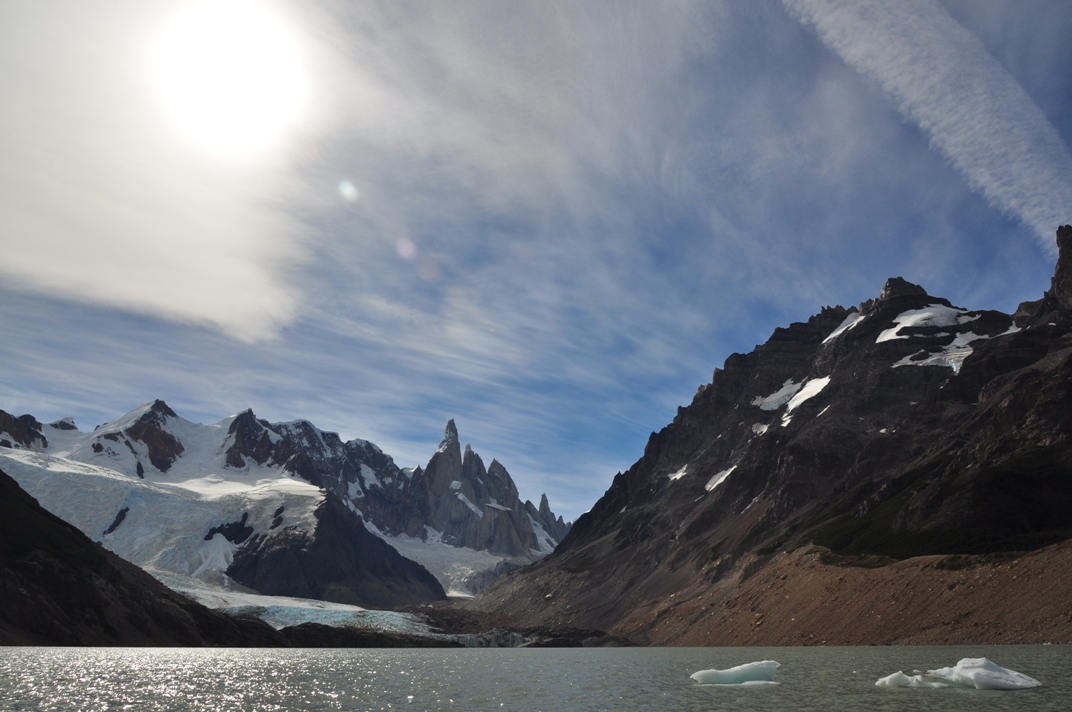
The lake at De Agostini, our first night in the park.  There are no entrance fees here...
...which means lots of people come.  

No mountain view behind us, but still a pretty nice sunrise at Poncenot.

Mike at a glacier lake just before being accosted by ´Papa´.

The town of El Calafate isn´t anything to write home about but the I Keu Ken hostel was great.  The main reason for visiting the town is to see the Perito Moreno glacier.  We rented a car and spent the day at the site.  If ever in Argentina it would be a real shame to not see this amazing place.  It is a huge glacier, some 7km wide and 25km long that is advancing at a rate of about 2m per day - one of the only glaciers in the world doing so, most are retreating.  The ice is about 60ft high and massive pieces regularly fall off making huge waves and noise.  If you stay long enough you can get a sense of where the next piece is going to fall from, which you wait for with great anticipation.  When it finally calves off your heart races a bit -


Sequence of a smaller piece falling.  Even the smallest piece of ice would make  huge sounds, like cannons.  Antarctica was amazing, but we didn´t see anything like this there.  

After meeting up with Mike and Kat again we went across the border into Chile to Puerto Natales, where again we stayed one night only and then straight into what the Lonely Planet describes as ´South America´s best managed national park´ at Torres del Paine (literally, ´Towers of Pain´ ha!).  Unfortunately in late December some idiot had illegally tried burning his toilet paper in 100km winds only to start a forest fire that burned about half the park (17,000 hectares).  We took a bus tour through some of the burn areas, where a chopper was still working putting out smaller fires, and then hiked for 4 days in areas where there was no fire.  Again it was packed and we didn´t really enjoy the park as much as in El Chalten.  And here we not only had to pay an entrance fee, we also had to pay to camp because somehow there is private land within the park.  I think the Lonely Planet should rethink its claim. We did see and hear pieces of ice falling off mountain tops in the French Valley and see a lake get pretty ripped up by incredible winds.  It was nice to camp but we´d had enough of the crowds by trek´s end.  We stayed three more nights in Puerto Natales at a great hostel (´The Tin House´) waiting until January 30 to board a 4 day ferry headed north to Puerto Montt in Chile.  Elise turned 33 on January 28.

You can see the Towers of Pain at middle-right.  Where it wasn´t burnt the park was beautiful...

...but much of it looked like this.

The winds were 80km/hr+.  Our tent was well protected but others weren´t so lucky.  Again there were lots of people.

Happy Birthday Elise!